
However not the fact only of his showing himself to Mary, but likewise the manner of it claims our attention. When first beholding him she did not know the Lord, and even after his speech she still supposed him to be the gardener. The chief cause for this may have lain in the change which had taken place in him when the mortal put on immortality. Now behold with what exquisite tact the Lord helps her to restore the broken bond between the image her memory retained of him and that new image in which henceforth he would walk through her life and hold converse with her spirit. Even these first words: “Women why weepest thou? Whom seekest thou?” though in form scarcely differing from the question of the angels, go far beyond the latter in their power to reach Mary’s heart. In the word “woman” with which he addresses her speaks all the majesty of one who felt himself the Son of God in power by resurrection from the dead. It is a prelude to the still more majestic, “Touch me not” spoken soon afterwards.
And yet in the words, “Why weepest thou? Whom seekest thou?” He extends to her that heart-searching sympathy which at a single glance can read and understand the whole secret of her sorrow. He knew that such weeping results only there where one who is more than father or mother has been taken away. And how instantaneous the effect these words produced! Though she still supposes him the gardener, she takes for granted that he at least could not have taken the body with evil intent, that he will not refuse to restore it: “Sir, if thou hast born him hence, tell me where thou hast laid him, and I will take him away” (Jn 20:15). A certain response to his sympathy is also shown in this, that three times she refers to Jesus as “him,” deeming it unnecessary to mention his name. Thus in the way she met the gardener there was already the beginning resumption of the bond of confidence between her and the Lord. And thus Jesus found the way prepared for making himself known to her in a most intimate manner. “Jesus saith unto her, Mary. She turneth and saith unto him, Rabboni” (Jn 20:16). It happened all in a moment, and by a simple word, and yet in this one moment Mary’s world was changed for her. She had in that instant made the transition from hopelessness because Jesus was absent, to fullness of joy because Christ was there. – Geerhardus Vos, Grace & Glory
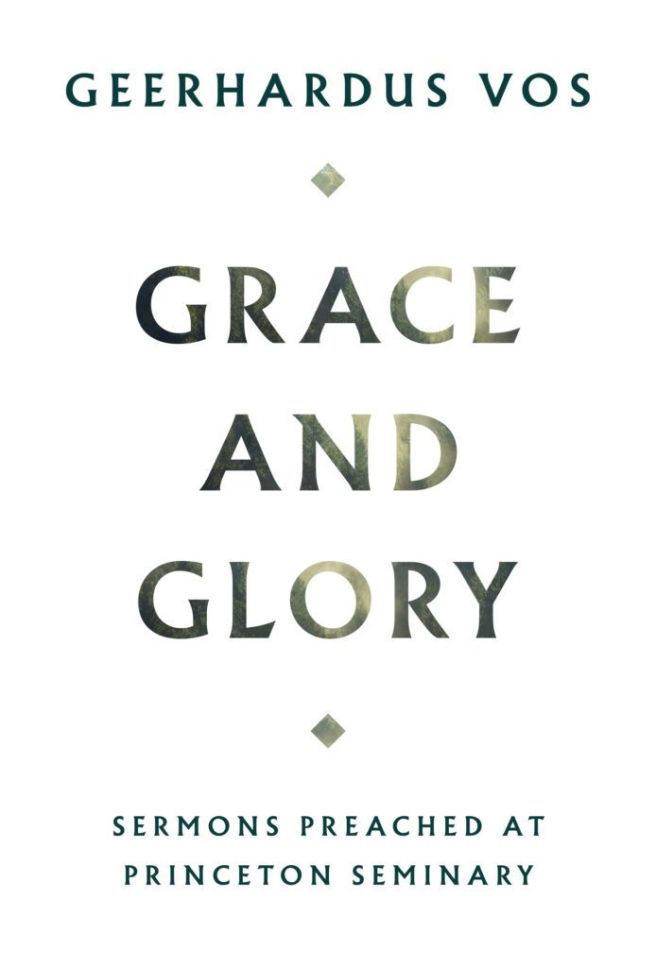
Publishers Description
In possessing a copy of Grace and Glory the reader has in his or her hands a book of sermons which are almost as rare as they are remarkable. Not only so, but in addition to the six sermons which originally constituted the volume Grace and Glory the present edition includes a further nine sermons which Vos preached in the Chapel of Princeton Theological Seminary between 1896 and 1913, as well as an undated exposition of Ephesians 2:4, 5 translated from Dutch. This additional material has been provided to the publishers by James T. Dennison, the Librarian of Westminster Theological Seminary in California and the editor of the journal Kerux, in which the bulk of it has already been printed. Mr Dennison originally uncovered Vos’s personal sermon book in 1971 in the Heritage Hall Archive of Calvin Theological Seminary and transcribed the material.
As heirs of his labours the publishers are also indebted to the Heritage Hall Archive of Calvin Seminary for the privilege of reproducing the material in this more permanent form. But the uniqueness of these sermons extends far beyond the difficulty of obtaining the original edition of Grace and Glory or the providences which led to the rediscovery of the manuscript material now in book form for the first time. It is the nature of the sermons themselves which will have a stunning effect on the reader. For they combine such constantly penetrating depths of biblical and theological understanding with such soaring heights of eloquence that it is difficult to imagine their like being heard in any pulpit in the world today. They are at one and the same time intensely demanding on the reader and glorious in their exposition of Scripture. These pages contain a thesaurus of theological riches, a gold mine whose every vein is packed with gleaming insight. Such is the character of these sermons that, to a world which is obsessed with ‘sound-bites’ and in a church which has become unused to concentrated thought, their content and style may seem almost overwhelming…In these pages the reader is invited, almost commanded and certainly demanded, to become a spiritual mountaineer. There are times when many will be left gasping for the higher oxygen levels of the lower slopes. But Vos was aiming for the summit, and those who follow him there will find panoramic views of the wonders of God and his ways which will make the ascent immensely rewarding.
Here, then, is material calculated to enrich the mind, heart, will and emotions; grace and glory indeed.
— From the Introduction by Sinclair B. Ferguson
 pro35.org